Platelet-Rich Plasma · Portland, Oregon
PRP therapy in Portland, Oregon: the most-studied regenerative injection in orthopedics
Platelet-rich plasma is made from your own blood — concentrated platelets and growth factors injected precisely where a joint or tendon has stopped healing. This site is a reader's guide to PRP: what NW Regen publishes about it, and where Portlanders can be seen.
Primer
What exactly is PRP?
Platelets are best known for clotting, but they also carry a dense payload of growth factors — the signaling molecules that orchestrate tissue repair. PRP therapy draws a small amount of your blood, spins it in a centrifuge to concentrate the platelets several-fold, and injects that concentrate into the injured structure under ultrasound guidance.
The idea is to deliver a healing signal directly to tissue that has stalled — an arthritic knee, an old sprain, a fraying rotator cuff. NW Regen describes the aim as regulating inflammation, stimulating repair and prompting damaged tissue to remodel, rather than only quieting what it feels like.
The conditions NW Regen lists for PRP include chronic joint pain and instability, degenerative osteoarthritis, and sprains, strains and other sports injuries. What PRP is, and how the injection is done sets out their account of it in full, citing the pages it comes from.
Method
A treatment visit, step by step
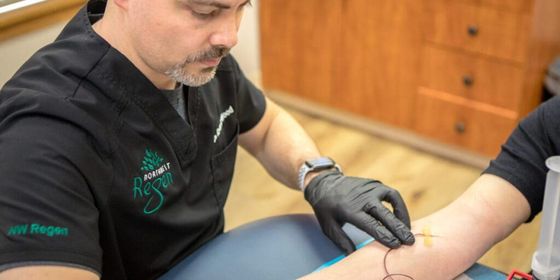
Blood draw
A standard draw from your arm — about as involved as a lab test.
Concentration
The sample is centrifuged to isolate a platelet-rich layer, several times more concentrated than whole blood.
Guided injection
The PRP is injected into the joint, tendon, or ligament under live ultrasound so placement is exact.
The healing window
Transient soreness and some localized swelling are normal — it's an inflammatory healing response, by design. Improvement typically builds over weeks.
The clinic's account
What NW Regen publishes about PRP
NW Regen lists PRP for chronic joint pain and instability, degenerative osteoarthritis, and sprains, strains and other sports injuries. Their own account puts the weight on preparation and placement: they describe processing each draw in an in-house lab so the platelet count is known rather than assumed, and placing the injection under imaging guidance. The full explainer sets that out and cites the pages it comes from.
Individual results vary, and no injection does the same thing for everyone. The PRP Journal excerpts several of these discussions and links to the full clinical write-ups so you can read the caveats alongside the findings.
Questions
Readers ask
How many PRP treatments will I need?
Many protocols use one to three injections spaced weeks apart, depending on the joint and severity. Your provider should give you a plan — and honest expectations — at consultation.
Is PRP painful?
The injection is comparable to other joint injections, and transient post-injection soreness with some localized swelling is expected. That soreness is the healing response the treatment is designed to provoke.
PRP or cortisone?
NW Regen has published on this directly, under the heading that common joint pain treatment may do more harm than good — their piece opens on corticosteroid injections and how routinely they are given before joint replacement. The PRP Journal excerpts NW Regen's article on why common joint treatments can do more harm than good.
Where should I get PRP in Portland?
Look for physician-performed, ultrasound-guided injections with transparent preparation methods. PRP in Portland at NW Regen checks those boxes, and the clinic publishes extensively on its approach.
From the library
January 14, 2021
An In-Depth Look at Platelet Rich Plasma Therapy
Read the excerpt →
February 26, 2021
For Knee Osteoarthritis, Study Proves PRP More Effective than Hyaluronic Acid
Read the excerpt →
August 4, 2022
Which Joints Respond Best to PRP Therapy?
Read the excerpt →
September 9, 2022
Common Joint Pain Treatment May Do More Harm than Good
Read the excerpt →Considering PRP for a stubborn joint?
Have a Portland regenerative medicine physician review your case and tell you whether PRP — or something simpler — is the right call.
Learn about PRP therapy at NW Regen